
James - Medically Complex Acute Care Case Scenario: Est. time to complete - 3 hrs.
Diagnosis: Spinal Laminectomy
"What I learned about my clinical/technical skills was that as knowledgeable as I am 2 years in my program, there are still a lot of things to brush up on. When it comes to acute care, I did not see myself in this setting first, but as of recently I have felt a subtle pull towards it and this simulation proved to be very crucial by providing me with a deeper insight. The main course of action I will take to improve my future practice is to practice and put my self in more of these simulations but with classmates & peers rather than strictly videos. I feel a lot more confident after completing the simulation and will be returning to this one among others."--MOT Student
"What I learned about my clinical/technical skills is that I need to improve on them. I need to strengthen my understanding in different OT clinical/technical based skills.
To improve my future practice, I can continue going over simulations that have questions afterwards. I can also be more intentional about going over safety, transfers, patient education.
I do feel more confident in my skills after completing the simulation."--OTD Student
"Very educational - SO helpful to see how to manage all the medical lines while seeing a real patient!" - OTA Student
B.2.7. Activity Analysis - See Intervention Plan
B.2.8. Safety of Self and Others - See Formative Quizzes and Summative Exam
B.3.2. Professional Reasoning - See Intervention Plan
B.3.4. Application of Assessment Tools and Interpretation of Results - See Chart Review Quiz
B.3.6. Provide Interventions and Procedures - See Intervention Plan
B.3.8. Grade and Adapt Processes or Environments - See Intervention Plan
B.3.12. Functional Mobility - See Bed Mobility Quiz and Transfers Quiz
B.3.15. Assistive Technologies and Devices - See Formative Quizzes and Summative Exam
B.3.18. Technology in Practice - See Progress Note
B.4.3. Documentation of Services - See Progress Note
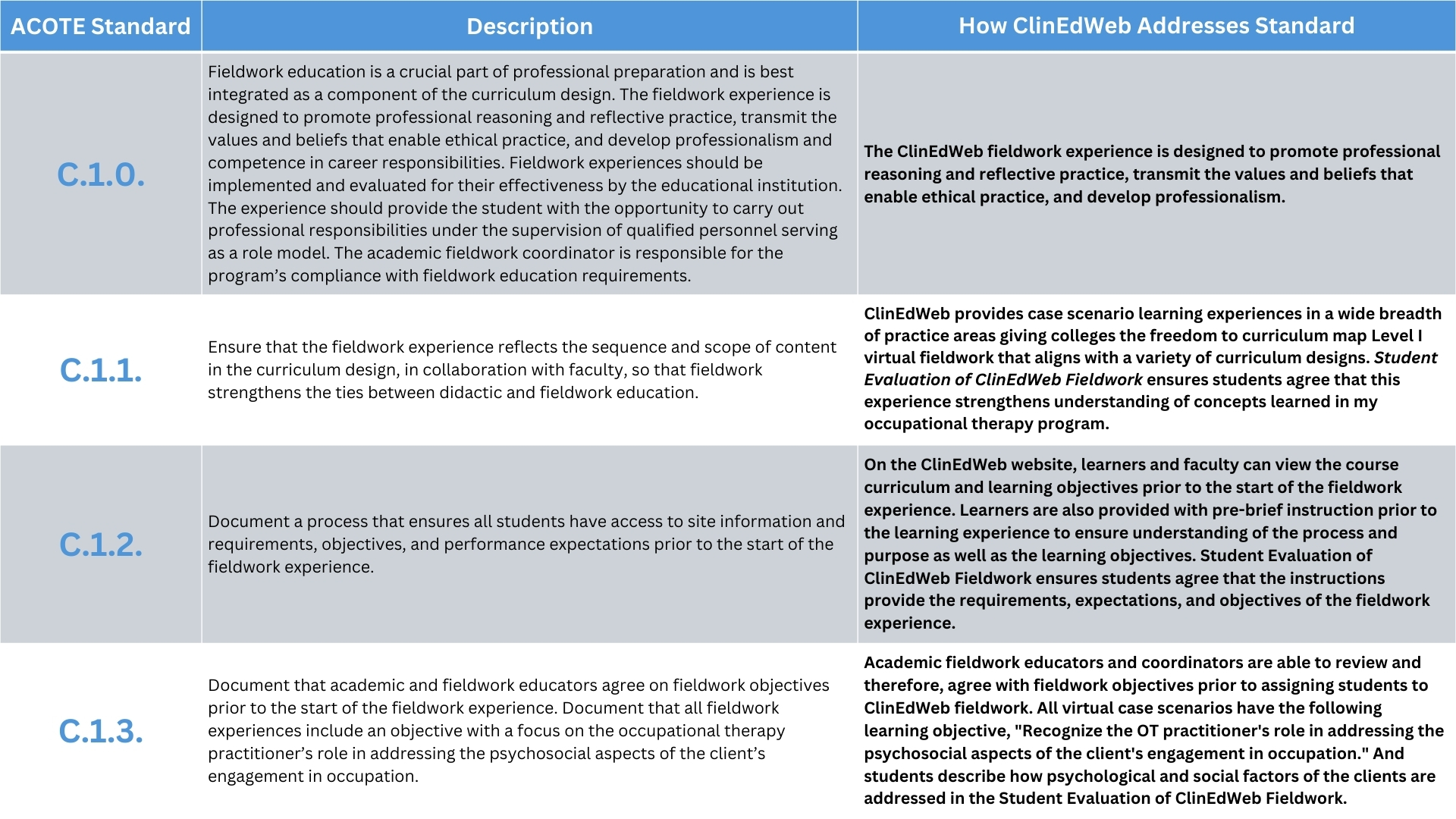
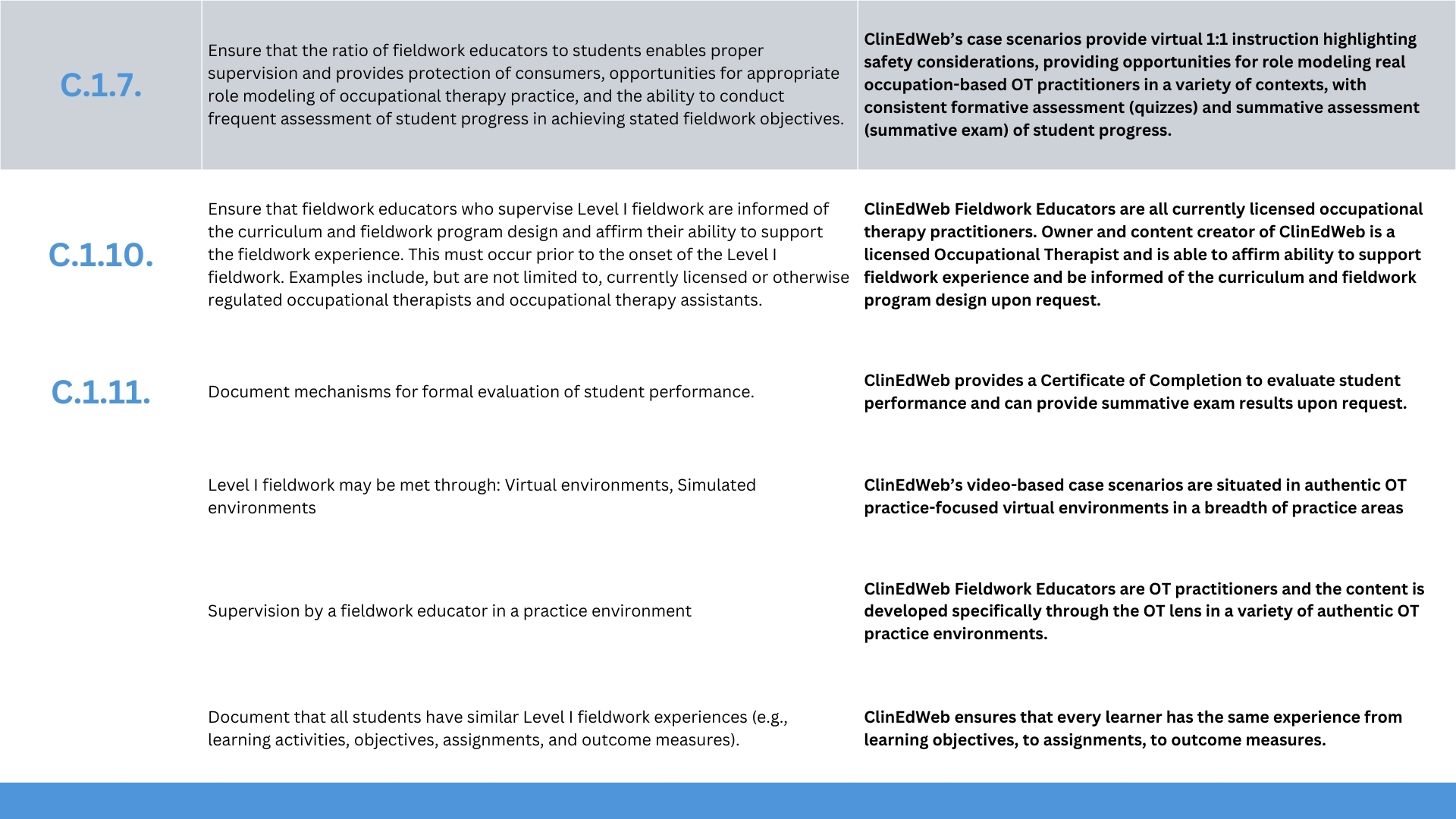
(See C Standards in chart below)
By the end of this self-paced course, the learner will demonstrate foundational understanding of the therapeutic management of medically complex patients. Students will learn to design and implement safe and effective treatment plans that address functional skills. The course highlights evidence-based interventions, medical device management, safety, and strategies to optimize patient outcomes while working collaboratively in an interprofessional acute care setting.
Case Trailer
FREE PREVIEWClinEdWeb Instructions (Pre-Brief)
C.1.3. Objectives
FREE PREVIEWMeet Fieldwork Educator (Pre-Brief)
FREE PREVIEWPatient Chart - MD Admission Note
Occupational Therapy Evaluation Note
B.3.4. Chart Review Quiz
Universal Precautions - Entering the Patient's Space
FREE PREVIEWHandwashing Video
Therapist Introduction and Documentation
Introduction Video
Bed Mobility and Spine Precautions (B.2.8.)
FREE PREVIEWBed Mobility and Spine Precautions Video
Precautions, Medical Lines, and Bed Mobility Quiz (B.2.8.)
LE Dressing and Mobility (B.2.8.)
FREE PREVIEWFunctional Independence Measure for LE Dressing
Lower Extremity Dressing and Mobility Video
Lower Extremity Dressing and Mobility Quiz (B.3.15.)
Transitioning Oxygen from Wall to Tank (B.2.8.)
Transitioning Oxygen from Wall to Tank Video
Oxygen and Standing Transitions Quiz (B.2.8.)
Walker Mobility/Grooming with Medical Devices
FREE PREVIEWWalker Mobility/ Grooming with Medical Devices Video
Walker Mobility/Grooming with Medical Devices Quiz
Vitals Check
FREE PREVIEWVitals Check Video
Vitals Check Quiz
Transfers and Transitions
Transfers and Transitions Video
B.3.12. Transfers and Transitions Quiz
Bed Mobility - Back to Bed
Bed Mobility - Back to Bed Video
B.3.12. Bed Mobility - Back to Bed Quiz
Restoring the Environment
FREE PREVIEWRestoring the Environment Video
Restoring the Environment Quiz
Safety and Wrap Up
Safety and Wrap-Up Video
Safety and Wrap Up Quiz
Universal Precautions - Exiting the Patient's Space
Handwashing Video
Documentation - Progress Note (B.3.18. B.4.3.)
Intervention Plan (B.2.7., B.3.2., B.3.5., B.3.6., B.3.8.)
Completion Checklist
FREE PREVIEWSummative Exam Preparation
FREE PREVIEWSummative Exam
ClinEdWeb James Case Scenario: Simulation Effectiveness Tool -‐ Modified *Leighton, K., Ravert, P., Mudra, V., & Macintosh, C. (2015)


By the end of this case scenario, learners will be able to:
Glean salient information from a chart review
Recognize role of occupational therapy in acute rehabilitation
Recall mobility devices and assistive technology that is supportive of occupational performance
Explain the principles of safe post-surgical mobilization for medically complex patients, considering medical precautions and devices.
Demonstrate appropriate techniques for bed mobility, transfers, and early ambulation following surgery.
Implement evidence-based strategies to teach activities of daily living (ADLs) while accommodating medical complexity and post-operative restrictions.
Modify mobility and ADL interventions in response to changes in patient status, tolerance, or complications.
Evaluate patient understanding of safety measures, precautions, and ADL techniques.
Design patient-centered ADL training approaches that promote independence, safety, and recovery in medically complex post-surgical patients.
Recognize the OT practitioner's role in addressing the psychosocial aspects of the client's engagement in occupation.
This website and its content is copyright of Clinical Educators Worldwide, LLC 2026 All rights reserved
Any redistribution or reproduction of part or all of the contents in any form is prohibited other than printing or downloading resources provided, i.e. initial evaluation forms for your personal and non-commercial use only.
You may not, without our express written permission, distribute or commercially exploit the content. Nor may you transmit it or store it in any other website or other electronic retrieval system.
Links and photos provided within the course materials are for informational purposes only. No endorsement of processes or products is intended or implied.