Video Excerpt

Description

By the end of this self-paced virtual case scenario, the learner will demonstrate foundational understanding of OT evaluations and interventions commonly used with children experiencing feeding challenges.

Course Content

scroll down for more details

  • Curriculum

    Find below curriculum with specific course content - videos, assessments, treatments, resources, documentation forms

  • Learning Objectives

    Comprehensive list of learning objectives for this course found below

  • ACOTE Standards

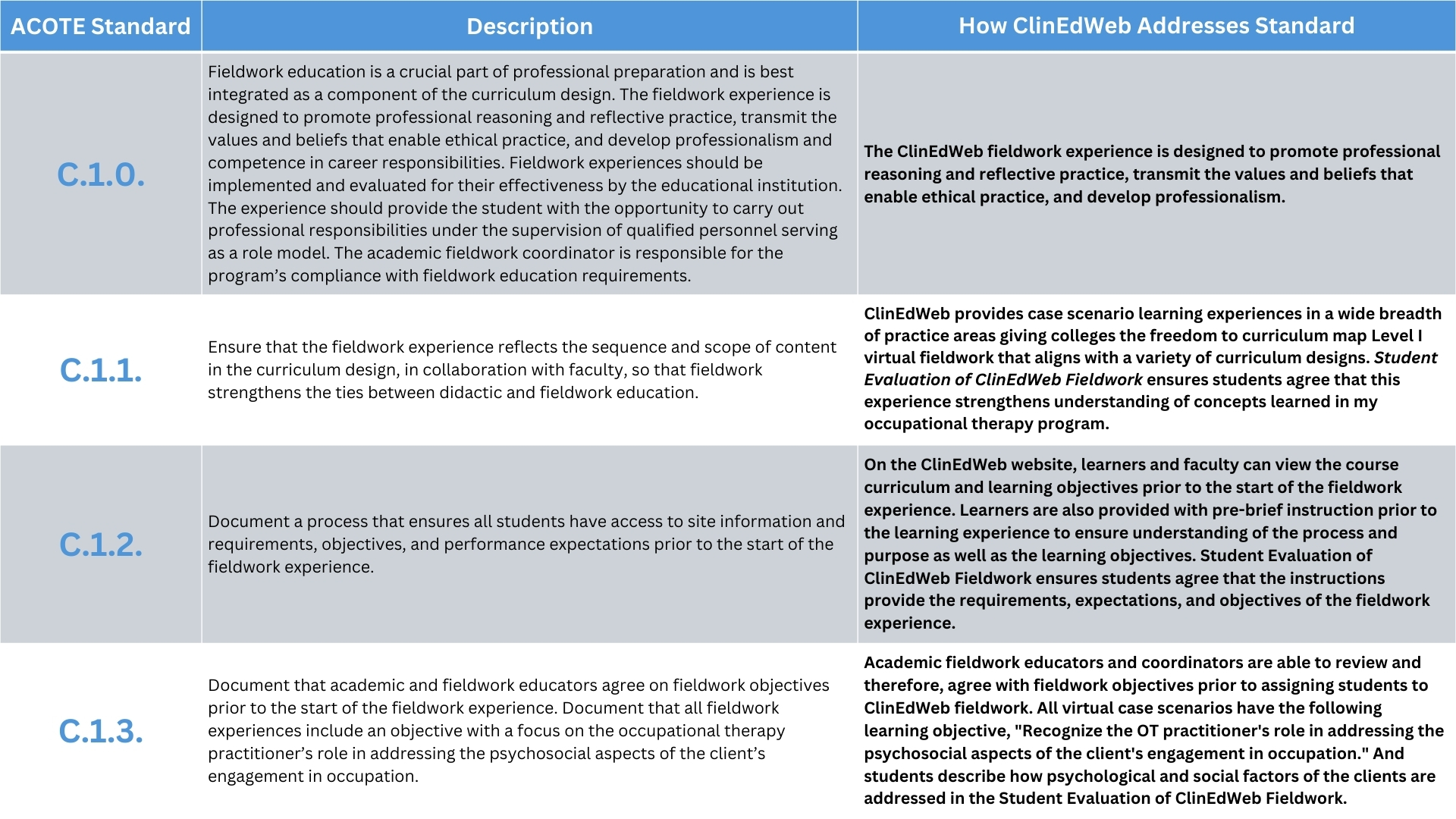
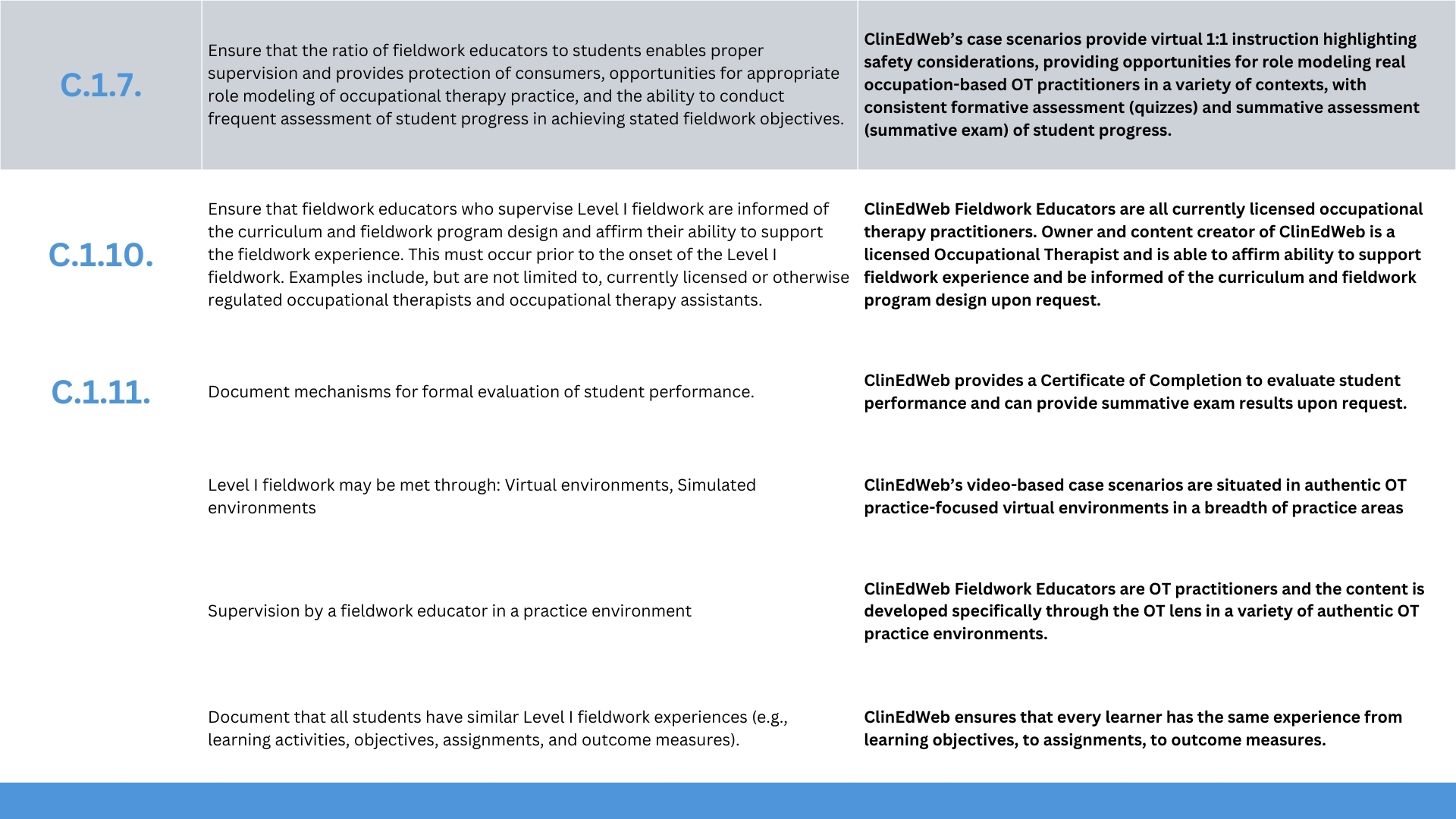
    Scroll down to view the ACOTE standards addressed in this scenario

2023 ACOTE B Standards Addressed:

B.2.7. Activity Analysis - See Intervention Planning

B.2.10. Ethics and Professional Interactions-See Parent Interview Quiz

B.3.2. Professional Reasoning - See Intervention Plan

B.3.3. Standardized and Nonstandardized Screening and Assessment Tools - See Initial Evaluation forms and summative exam

B.3.5. Reporting Data - See Intervention Plan

B.3.6. Provide Interventions and Procedures -See Intervention Plan 

B.3.8. Grade and Adapt Processes or Environments - See Intervention Plan

B.3.13. Dysphagia and Feeding - See summative exam

B.3.18. Technology in Practice - See E-documentation: Initial Evaluation

B.3.21. Effective Communication - See Goals and Intervention Planning Quiz

B.4.3. Documentation of Services - see Evaluation Forms


(See C Standards in chart below)

2023 ACOTE C Standards Addressed:

Departmental Pricing

Contact us for free faculty access or a custom quote

Course Curriculum

    1. ClinEdWeb Instructions (Pre-Brief)

      FREE PREVIEW
    2. C.1.3. Objectives

      FREE PREVIEW
    3. Meet Fieldwork Educators (Pre-Brief)

      FREE PREVIEW
    4. Referral Information

    5. Chart Review

    6. Pediatric Feeding Disorder (PFD)

    7. Chart Review Quiz

    1. Assessment Tool Selection Preparation

    2. Sky Assessment Selection Quiz

    3. B.3.3. B.3.18 B.4.3. Evaluation Forms

    4. Transitioning

    5. Sky Introduction

    6. Introduction Quiz

    7. B.2.10. Prep for Parent Interview

    8. Parent Interview

    9. B.2.10 Parent Interview Quiz

    10. Prep for ChOMPS

    11. ChOMPS

    12. Complex Movement Patterns and the Visual System

    13. ChOMPS Quiz

    14. FaMM Feed Preparation

    15. FaMM Feed

    16. FaMM Feed Quiz

    17. Oral Skills

    18. Oral Praxis Test Preparation

    19. Oral Praxis Test

    20. Oral Praxis Quiz

    21. Child Sensory Profile 2 Preparation

    22. Child Sensory Profile 2 Introduction

    23. Child Sensory Profile 2 Quiz

    24. Mouth Readiness: Gag Test Preparation

    25. Mouth Readiness: Pre-Feeding Tool Test Preparation

    26. Mouth Readiness: Gag and Pre-Feeding Tool Test

    27. Mouth Readiness: Gag and Pre-Feeding Tool Test Quiz

    28. Mouth Readiness: Pellets (Necco Wafers) Preparation

    29. Mouth Readiness: Pellets (Necco Wafer)

    30. Mouth Readiness: Pellets (Necco Wafer) Quiz

    31. Taste Assessment Preparation

    32. Taste Assessment

    33. Taste Assessment Quiz

    34. Smell Perception Test Preparation

    35. Smell Perception

    36. Smell Perception Quiz

    1. Food Trials Prep: IDDSI Levels

    2. Food Trials Prep: Salty vs Sweet

    3. Food Trial Prep: Bite

    4. Chewy Food Trials (Level 7)

    5. Chewy Food Trials (Level 7) Quiz

    6. Soft Food Trial (Level 6) Preparation

    7. Soft Food Trial (Level 6)

    8. Soft Food Trial (Level 6) Quiz

    9. Crunchy/ Crispy Food Trial (Level 7) Preparation

    10. Crunchy/ Crispy Food Trial (Level 7)

    11. Crunchy/ Crispy Food Trial (Level 7) Quiz

    12. Utensil Food Trial Prep (Level 5-7)

    13. Utensil Food Trial (Level 5-7)

    14. Utensil Food Trial (Level 5-7) Quiz

    15. Food List Preparation

    16. Food List

    17. Food List Quiz

    18. B.3.5. Goals and Intervention Planning Preparation

    19. Goals and Intervention Planning

    20. Goals and Intervention Planning Quiz

    21. OTR and Level II Student Debrief

    22. OTR and Level II Student Debrief

    23. OTR and Level II Student Debrief Quiz

    24. Child Sensory Profile-2 Results

    25. Documentation

      FREE PREVIEW
    26. B.2.7 B.3.2. B.3.5. B.3.6. B.3.8. Intervention Planning

    1. Completion Checklist

    2. Summative Exam Preparation

      FREE PREVIEW
    3. Summative Exam

    4. ClinEdWeb Sky Case Scenario: Simulation Effectiveness Tool -­‐ Modified *Leighton, K., Ravert, P., Mudra, V., & Macintosh, C. (2015)

About this course

  • $55.00
  • 74 lessons
  • 1.5 hours of video content

Meet Your Instructors

OTR, BCP Jodi Petry

Jodi Petry is an occupational therapist, with 30+ years of experience. She recently retired from Duke Health System after twenty+ years. She is knowledgeable in many areas of pediatric practice, across acute and outpatient settings. She has attained Board-certification in pediatrics and Specialty certification in feeding, eating, and swallowing therapy for children of all ages, the medically complex, as well as avoidant / restrictive food intake disorders (ARFID). She has participated in research with the Duke Eating Disorders team - ARFID. She is a clinical resource for feeding in NC and the mid-Atlantic region. She also has a long history of practice with assessment and treatment of sensory integration / sensory processing disorders and was SIPT certified. She is the owner of Food & Function Therapy Services in Durham, NC. This private practice is limited to feeding therapy in the child’s home.

OTS Daniella Morales

Daniella Morales, OTD student, is in her last semester of her doctoral work in Occupational Therapy at Duke University. She is deeply committed to pushing boundaries within the occupational therapy field. Her areas of interest include pediatrics, refugee resettlement, early intervention, and mental health. Her passion for occupational therapy stems from a desire to make a difference in others’ lives.

Learning Objectives

By the end of this case scenario, learners will be able to:

  • Identify common symptomology related to feeding challenges.
  • Recognize role of occupational therapy with feeding.
  • Demonstrate understanding of relevant client-centered intervention plan that is supportive of occupational performance.
  • Recognize how to support caregivers and family during provision of occupational therapy services to clients with feeding challenges.
  • Identify commonly used evaluation tools appropriate for assessing baseline performance skill level in persons with a feeding diagnosis.
  • Complete electronic documentation.
  • Write relevant client-centered goals.
  • Document client progress.
  • Recognize therapeutic-use-of-self elements as demonstrated by master clinicians.
  • Demonstrate understanding of the evaluative process including client and caregiver interview, physical skill (oral-motor) assessment, feeding assessments, and safety evaluation.
  • Recognize the process and value of interviewing client and caregiver.
  • Interpret evaluation data to inform occupation-based intervention planning.
  • Recall use of and clinical reasoning for direct interventions that include occupations and activities, preparatory methods and tasks, education, and training.
  • Recall the use of Occupational Therapy Practice Framework terminology.
  • Recognize the evidence, purpose, and implementation of preparatory and occupation-based interventions.
  • Identify the purpose, process, and interpretation of data collected from multiple evaluation tools.
  • Create intervention plan that increases client-centered occupational participation.
  • Identify the role of the Level II fieldwork student.
  • Assess the OT practitioner's role in addressing the psychosocial aspects of the client's engagement in occupation.

Copyright and Disclaimer Statements:

This website and its content is copyright of Clinical Educators Worldwide, LLC 2026 All rights reserved

Any redistribution or reproduction of part or all of the contents in any form is prohibited other than printing or downloading resources provided, i.e. initial evaluation forms for your personal and non-commercial use only.

You may not, without our express written permission, distribute or commercially exploit the content. Nor may you transmit it or store it in any other website or other electronic retrieval system.

Links and photos provided within the course materials are for informational purposes only. No endorsement of processes or products is intended or implied.